Introduction
Artificial Intelligence has become one of the most talked-about technologies in the modern world. From smartphones and voice assistants to online shopping recommendations and self-driving vehicles, AI is influencing how people live, work, and communicate. As technology continues to evolve, understanding artificial intelligence is becoming increasingly important for students, professionals, business owners, and everyday users.
Many people hear the term AI regularly but are unsure about what it actually means. Some imagine robots taking over the world, while others think it is simply another software tool. The truth lies somewhere in between. Artificial intelligence is a broad field of technology that enables machines to perform tasks that typically require human intelligence.
Today, AI is used in healthcare, education, finance, transportation, manufacturing, entertainment, and countless other industries. It helps organizations improve efficiency, reduce costs, and make better decisions based on data.
This beginner-friendly guide explains the fundamentals of artificial intelligence in simple language. You will learn what AI is, why it matters, how it works, its advantages and risks, and how beginners can start learning about it. By the end of this article, you will have a strong understanding of artificial intelligence and its growing role in the digital world.
What is Artificial Intelligence?

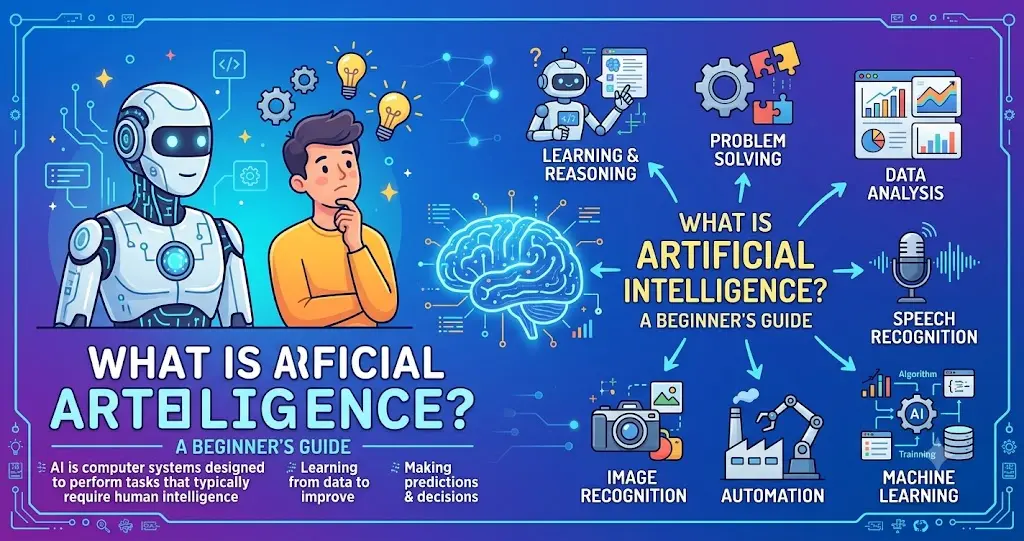
Artificial Intelligence, often abbreviated as AI, refers to the ability of computers and machines to perform tasks that normally require human intelligence. These tasks include learning, problem-solving, decision-making, language understanding, image recognition, and pattern detection.
In simple terms, artificial intelligence allows machines to think, learn, and respond in ways that resemble human behavior. Instead of following only fixed instructions, AI systems can analyze information, identify patterns, and improve their performance over time.
For example:
- Virtual assistants can answer questions.
- Streaming platforms recommend content based on viewing habits.
- Email services filter spam messages automatically.
- Navigation apps suggest the fastest routes.
- Online stores recommend products users may like.
Artificial intelligence works by processing large amounts of data and using algorithms to make predictions or decisions. The more quality data an AI system receives, the better it can learn and perform.
AI is commonly divided into different categories:
- Narrow AI
- General AI
- Super AI
Narrow AI is the most common form today. It is designed for specific tasks, such as voice recognition or recommendation systems. General AI, which would perform any intellectual task like a human, remains under development. Super AI is a theoretical concept describing intelligence beyond human capabilities.
Why is Artificial Intelligence Important?
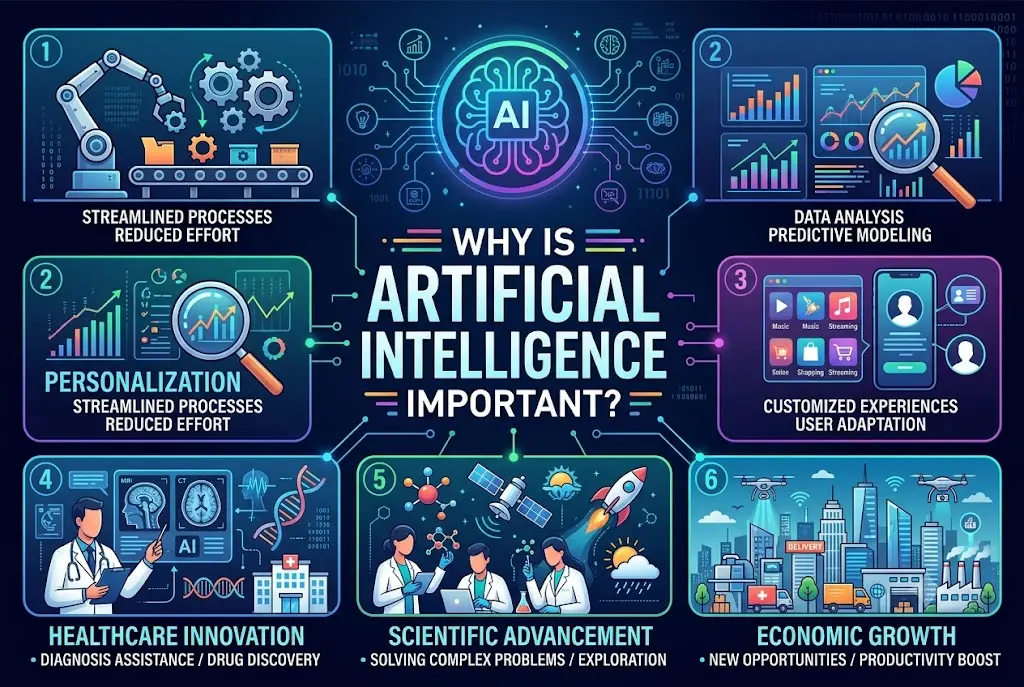
Artificial intelligence is important because it helps solve complex problems quickly and efficiently. Businesses, governments, schools, and healthcare providers increasingly rely on AI to improve productivity and decision-making.
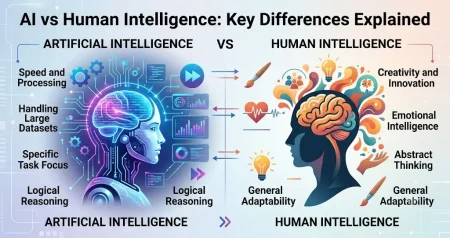
One major reason AI is valuable is its ability to process massive amounts of information within seconds. Humans may take days or weeks to analyze large datasets, while AI systems can complete the same task much faster.
AI also improves accuracy. In industries such as healthcare, artificial intelligence helps doctors identify diseases earlier by analyzing medical images and patient data.
Another reason for its importance is automation. Repetitive tasks that once required significant human effort can now be completed automatically, allowing people to focus on more creative and strategic work.
Artificial intelligence also drives innovation. It supports the development of advanced technologies such as smart assistants, autonomous vehicles, predictive analytics, and intelligent robotics.
As digital transformation continues worldwide, AI is becoming a critical tool for competitiveness and growth across nearly every industry.
Detailed Step-by-Step Guide
Step 1: Understand the Basics of AI
Before exploring advanced concepts, learn the fundamental definition of artificial intelligence and its core objectives.
Focus on understanding:
- Machine learning
- Data analysis
- Automation
- Pattern recognition
- Decision-making systems
Building a strong foundation helps beginners understand more advanced topics later.
Step 2: Learn About Data
Data is the fuel that powers AI systems. Without data, artificial intelligence cannot learn or improve.
Examples of data include:
- Images
- Videos
- Text documents
- Customer records
- Audio files
- Sensor readings
The quality and quantity of data significantly affect AI performance.
Step 3: Understand Machine Learning
Machine learning is a branch of artificial intelligence that enables computers to learn from data without being explicitly programmed for every situation.
Instead of following rigid instructions, machine learning models identify patterns and make predictions.
Examples include:
- Fraud detection
- Product recommendations
- Weather forecasting
- Speech recognition
Machine learning forms the foundation of many modern AI applications.
Step 4: Explore Neural Networks
Neural networks are computing systems inspired by the human brain. They consist of interconnected nodes that process information and identify relationships within data.
These networks are particularly useful for:
- Image recognition
- Language translation
- Speech processing
- Medical diagnosis
Deep learning, a specialized area of AI, relies heavily on neural networks.
Step 5: Learn How AI Makes Decisions
Artificial intelligence systems analyze data, identify patterns, and generate outputs based on learned information.
A simplified process includes:
- Collecting data
- Cleaning data
- Training a model
- Testing accuracy
- Making predictions
- Improving performance
This cycle helps AI become increasingly effective over time.
Step 6: Explore Real-World Applications
Understanding practical applications makes learning artificial intelligence more meaningful.
Popular AI applications include:
- Virtual assistants
- Recommendation systems
- Chatbots
- Smart home devices
- Autonomous vehicles
- Medical diagnostics
These examples demonstrate how AI impacts daily life.
Step 7: Start Practicing AI Skills
Beginners interested in artificial intelligence should gradually build technical knowledge.
Useful areas to study include:
- Mathematics
- Statistics
- Programming
- Data science
- Machine learning concepts
Consistent practice helps transform theoretical knowledge into practical skills.
Benefits of Artificial Intelligence
Artificial intelligence offers numerous advantages across different industries and everyday activities.
- Increases productivity by automating repetitive tasks
- Improves decision-making through data analysis
- Enhances customer experiences with personalization
- Reduces human error in many processes
- Operates continuously without fatigue
- Supports faster problem-solving
- Improves medical diagnosis accuracy
- Helps businesses reduce operational costs
- Enables predictive maintenance in manufacturing
- Strengthens fraud detection and cybersecurity systems
- Provides personalized learning experiences in education
- Accelerates scientific research and innovation
These benefits explain why organizations continue investing heavily in AI technologies.
Disadvantages / Risks
Despite its advantages, artificial intelligence also presents several challenges and concerns.
- Potential job displacement through automation
- High development and implementation costs
- Dependence on large amounts of quality data
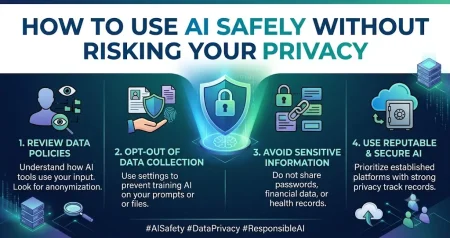
- Privacy concerns related to data collection
- Algorithmic bias that may create unfair outcomes
- Security risks if systems are compromised
- Lack of transparency in some AI models
- Ethical concerns regarding decision-making
- Risk of misinformation through automated content generation
- Overreliance on technology
Understanding these risks helps organizations implement AI responsibly and ethically.
Common Mistakes to Avoid
Many beginners make avoidable mistakes when learning about artificial intelligence.
One common mistake is believing that AI can solve every problem. While powerful, artificial intelligence has limitations and requires proper implementation.
Another mistake is ignoring the importance of data quality. Poor-quality data often leads to inaccurate results and unreliable predictions.
Some people focus only on tools while neglecting foundational concepts. Understanding statistics, data analysis, and machine learning principles is essential for long-term success.
Many beginners also expect immediate results. Learning artificial intelligence takes time, patience, and continuous practice.
Another error involves overlooking ethical considerations. Responsible AI development requires fairness, transparency, and accountability.
Finally, some organizations adopt AI simply because it is popular rather than because it solves a genuine business problem. Successful implementation starts with clear objectives and measurable goals.
What is artificial intelligence in simple words?
Artificial intelligence is technology that allows computers and machines to perform tasks that usually require human intelligence, such as learning, reasoning, problem-solving, and decision-making.
How does artificial intelligence work?
AI works by analyzing data, identifying patterns, learning from information, and making predictions or decisions based on what it has learned. Algorithms and machine learning models play key roles in this process.
Is artificial intelligence the same as machine learning?
No. Machine learning is a subset of artificial intelligence. AI is the broader field, while machine learning focuses specifically on enabling systems to learn from data.
Where is artificial intelligence used today?
Artificial intelligence is used in healthcare, education, finance, transportation, retail, manufacturing, customer service, cybersecurity, and entertainment.
Can beginners learn artificial intelligence?
Yes. Beginners can start by learning basic concepts, mathematics, programming fundamentals, and machine learning principles. Many educational resources are designed specifically for newcomers.
Will artificial intelligence replace human jobs?
AI may automate certain repetitive tasks, but it is also creating new job opportunities. Many experts believe future workplaces will combine human skills with AI-powered tools.
What programming language is commonly used for AI?
Python is one of the most popular programming languages for artificial intelligence because of its simplicity and extensive libraries for machine learning and data analysis.
Is artificial intelligence safe?
Artificial intelligence can be safe when developed and used responsibly. However, organizations must address issues such as privacy, security, fairness, and ethical decision-making.
Expert Tips & Bonus Points
If you want to understand artificial intelligence more effectively, focus on building a strong foundation before exploring advanced topics.
Consider these expert recommendations:
- Learn basic programming concepts gradually.
- Understand statistics and probability fundamentals.
- Study real-world AI applications regularly.
- Follow technology trends and industry developments.
- Practice analyzing datasets whenever possible.
- Develop critical thinking skills.
- Explore machine learning concepts step by step.
- Focus on solving practical problems.
- Stay informed about AI ethics and regulations.
- Build small projects to reinforce learning.
Bonus Tip:
Instead of trying to learn everything at once, choose one area of artificial intelligence that interests you most. Consistent progress over time is far more effective than attempting to master multiple complex topics simultaneously.
Conclusion
Artificial intelligence is transforming the way people interact with technology and shaping the future of countless industries. From virtual assistants and recommendation systems to healthcare diagnostics and business automation, AI has become an essential part of modern life. Understanding the basics of artificial intelligence is no longer limited to technology professionals. It is increasingly valuable for students, entrepreneurs, employees, and anyone interested in the digital world.
As discussed throughout this guide, artificial intelligence refers to machines performing tasks that traditionally require human intelligence. It relies on data, algorithms, machine learning, and continuous improvement to generate useful insights and decisions. While AI offers significant benefits such as improved efficiency, better accuracy, and enhanced productivity, it also presents challenges related to privacy, ethics, security, and employment.
The key to understanding artificial intelligence is approaching it step by step. Begin with the fundamentals, learn how data and machine learning work, explore practical applications, and gradually build your knowledge through consistent study and practice.
Artificial intelligence will continue evolving and influencing nearly every aspect of society. Those who understand its capabilities, limitations, and opportunities will be better prepared to adapt and succeed in an increasingly technology-driven world. Whether your goal is personal growth, career advancement, or simple curiosity, learning about AI today is an investment in the future.