Introduction
The future of electric vehicles is becoming one of the most talked-about topics in the transportation industry. Governments, automakers, and consumers are increasingly investing in cleaner technologies to reduce pollution and dependence on fossil fuels. As climate concerns continue to grow, electric vehicles are no longer viewed as niche products. Instead, they are becoming a practical option for everyday transportation. Modern EVs offer improved driving ranges, advanced safety features, and lower operating costs than many traditional gasoline-powered vehicles.
Over the past decade, significant technological improvements have transformed the electric vehicle market. Better battery technology, faster charging systems, and expanding charging networks have encouraged more people to consider making the switch. At the same time, governments are introducing incentives, stricter emission regulations, and investments in charging infrastructure to support the transition toward cleaner transportation.
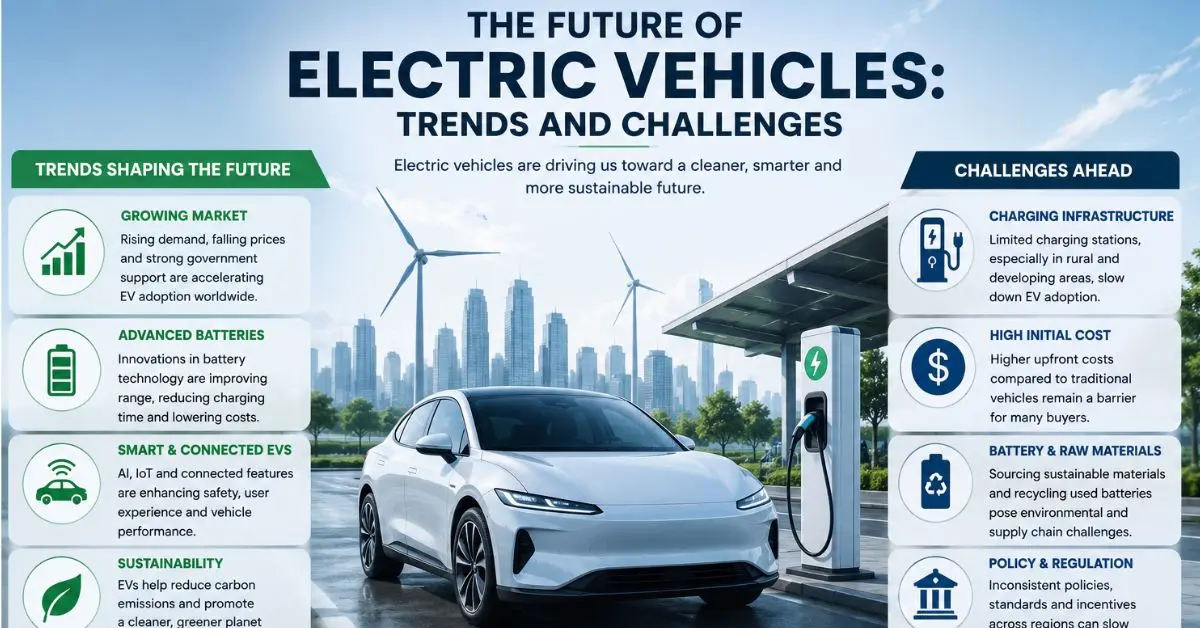
However, despite rapid progress, several challenges still remain. Battery production costs, charging accessibility, raw material availability, and recycling concerns continue to influence the growth of the industry. Consumers also have questions about vehicle affordability, maintenance, and long-term reliability.
Understanding the future of electric vehicles helps buyers, businesses, and policymakers prepare for upcoming changes. Whether you are planning to purchase your first EV or simply want to stay informed, learning about emerging trends and current obstacles provides valuable insights into where transportation is heading.
This guide explores the future of electric vehicles in detail, covering important trends, common challenges, practical developments, advantages, disadvantages, frequently asked questions, and expert recommendations to help you understand this rapidly evolving industry.
What is the Future of Electric Vehicles?

The future of electric vehicles refers to the ongoing development and adoption of automobiles powered primarily by electricity instead of gasoline or diesel fuel. These vehicles use rechargeable battery packs to power electric motors, producing zero tailpipe emissions while delivering smooth and efficient performance.
Unlike conventional vehicles that rely on internal combustion engines, electric vehicles convert stored electrical energy directly into motion. This process significantly improves energy efficiency and reduces environmental impact.
Several types of electric vehicles are currently available, including:
- Battery Electric Vehicles (BEVs)
- Plug-in Hybrid Electric Vehicles (PHEVs)
- Hybrid Electric Vehicles (HEVs)
- Fuel Cell Electric Vehicles (FCEVs)
Battery electric vehicles represent the fastest-growing segment because they operate entirely on electricity without requiring gasoline.
The future of electric vehicles is driven by continuous innovation. Manufacturers are investing heavily in battery research, artificial intelligence, autonomous driving, lightweight materials, and connected vehicle technologies. These improvements aim to make EVs more affordable, efficient, and convenient for consumers around the world.
As charging infrastructure expands and renewable energy becomes more common, electric vehicles are expected to play a major role in reducing greenhouse gas emissions and creating a more sustainable transportation system.
Why is the Future of Electric Vehicles Important?

The future of electric vehicles affects individuals, businesses, governments, and the global environment. Transportation is responsible for a significant share of carbon emissions, making cleaner mobility an essential part of climate action.
Some key reasons why electric vehicles are important include:
- Reduced air pollution in cities.
- Lower greenhouse gas emissions.
- Reduced dependence on imported oil.
- Lower fuel and maintenance costs.
- Increased energy efficiency.
- Support for renewable energy integration.
- Technological innovation and economic growth.
- Creation of new jobs in manufacturing and infrastructure.
Consumers also benefit from quieter driving experiences, fewer moving engine parts, and reduced maintenance requirements. Electric motors require less servicing than traditional engines because they eliminate components such as oil filters, spark plugs, and exhaust systems.
Many countries have announced plans to gradually phase out new gasoline-powered vehicle sales during the coming decades. This makes understanding the future of electric vehicles increasingly important for both consumers and businesses making long-term investment decisions.
Step-by-Step Guide to Understanding the Future of Electric Vehicles
Step 1: Follow Battery Technology Advancements
Battery technology remains the foundation of every electric vehicle. Improvements in battery performance directly influence driving range, charging speed, safety, lifespan, and overall vehicle affordability.
Lithium-ion batteries currently dominate the market because they offer high energy density and reliable performance. However, researchers continue exploring next-generation battery technologies that promise even greater efficiency.
One of the most exciting developments is solid-state battery technology. Unlike conventional lithium-ion batteries that use liquid electrolytes, solid-state batteries use solid materials, offering several potential advantages.
Expected improvements include:
- Longer driving ranges.
- Faster charging times.
- Increased safety.
- Longer battery lifespan.
- Reduced battery degradation.
- Better performance in extreme temperatures.
Another important trend involves reducing battery costs. Battery prices have declined significantly over the past decade, making electric vehicles more affordable for average consumers. Continued improvements in manufacturing processes and economies of scale are expected to lower prices even further.
Battery recycling is also becoming increasingly important. Recovering valuable materials such as lithium, nickel, cobalt, and graphite helps reduce environmental impact while supporting future battery production.
Automakers are investing billions of dollars in battery manufacturing facilities to secure stable supply chains and meet growing consumer demand. Governments are supporting these investments through incentives, research funding, and industrial partnerships.
As battery technology continues improving, consumers can expect longer-lasting vehicles, lower ownership costs, faster charging experiences, and greater confidence in adopting electric transportation.
Step 2: Watch Charging Infrastructure Expand
A reliable charging network is essential for the future of electric vehicles. Even the most advanced EV becomes less practical if drivers cannot conveniently recharge it. Fortunately, governments, utility companies, and private businesses are investing heavily in expanding charging infrastructure across cities, highways, workplaces, and residential areas.
Home charging remains the most convenient option for many owners. Charging overnight allows drivers to start each day with a full battery while avoiding visits to public charging stations. Apartment buildings and residential communities are also beginning to install shared charging facilities to support increasing EV ownership.
Public charging networks continue to grow rapidly. Fast chargers can significantly reduce charging times, making long-distance travel more practical. Many shopping centers, hotels, restaurants, office buildings, and parking facilities now offer charging stations to attract customers and support sustainable transportation.
Another important trend is ultra-fast charging technology. New charging systems are designed to deliver substantial battery capacity within a short period, reducing waiting times for travelers. As battery technology improves alongside charging equipment, the overall ownership experience becomes more convenient.
Wireless charging is another innovation attracting attention. Instead of plugging in a cable, future electric vehicles may recharge simply by parking over specially designed charging pads. Although still developing, this technology could simplify charging for both personal and commercial vehicles.
Smart charging systems are also becoming more common. These systems automatically schedule charging during periods of lower electricity demand, helping reduce costs while balancing pressure on electrical grids. Vehicle owners can often manage charging schedules through smartphone applications, improving convenience and efficiency.
Governments continue supporting charging infrastructure through grants, tax incentives, and public-private partnerships. As more charging stations become available, concerns about range anxiety are expected to decline, encouraging wider EV adoption.
Step 3: Understand Government Policies and Incentives
Government support plays a major role in shaping the future of electric vehicles. Around the world, policymakers recognize that cleaner transportation is necessary to reduce emissions, improve public health, and achieve climate goals.
Many governments offer financial incentives that reduce the purchase price of electric vehicles. These incentives may include tax credits, rebates, registration discounts, or reduced import duties. Such programs help narrow the price difference between electric and gasoline-powered vehicles.
Emission regulations are becoming increasingly strict. Automakers are under pressure to produce cleaner vehicles and reduce fleet-wide emissions. This encourages manufacturers to expand their electric vehicle offerings and accelerate research into new technologies.
Several countries have announced future deadlines to phase out the sale of new gasoline and diesel vehicles. While timelines differ, these announcements send a clear signal that electric mobility will become increasingly important over the coming decades.
Governments are also investing in charging infrastructure, battery manufacturing, renewable energy projects, and workforce training. These investments strengthen the overall EV ecosystem while supporting economic development.
In addition, public transportation systems are adopting electric buses, delivery companies are electrifying commercial fleets, and municipalities are introducing electric service vehicles. These efforts demonstrate how government leadership can accelerate widespread adoption beyond private passenger cars.
Consumers should monitor local policies because incentives, regulations, and charging programs vary by region. Understanding available benefits can significantly reduce ownership costs.
Step 4: Observe Advances in Vehicle Technology
Electric vehicles are becoming smarter as well as cleaner. Modern EVs increasingly combine electric propulsion with advanced software, connectivity, and intelligent safety systems.
Many new electric vehicles receive software updates over the air, allowing manufacturers to improve performance, add features, and enhance security without requiring dealership visits. This capability keeps vehicles current throughout their lifespan.
Driver assistance technologies continue improving as well. Features such as adaptive cruise control, lane-keeping assistance, automatic emergency braking, and intelligent parking systems make driving safer and more comfortable.
Artificial intelligence also plays an important role. AI helps optimize battery performance, estimate remaining driving range, improve navigation, and recommend efficient charging locations based on traffic conditions and battery status.
Connected vehicle technology enables communication between vehicles, charging stations, and infrastructure. Drivers receive real-time information about charging availability, weather conditions, road closures, and energy consumption.
Autonomous driving remains an area of active development. Although fully self-driving vehicles are not yet widespread, electric vehicles often serve as ideal platforms for testing advanced automation technologies because of their modern electronic architectures.
Lightweight materials, improved aerodynamics, and more efficient electric motors further increase driving range while reducing energy consumption. Every technological improvement contributes to making electric vehicles more practical for everyday use.
Benefits of the Future of Electric Vehicles
The continued growth of electric vehicles offers numerous advantages for individuals, businesses, and society.
- Lower greenhouse gas emissions compared to conventional vehicles.
- Reduced air pollution in urban environments.
- Lower fuel costs because electricity is often less expensive than gasoline.
- Reduced maintenance requirements due to fewer moving parts.
- Quieter driving experience with less noise pollution.
- Improved energy efficiency.
- Increased use of renewable energy sources.
- Enhanced technological features and software updates.
- Better driving performance through instant electric motor torque.
- Reduced dependence on fossil fuels.
- Support for national energy security.
- Creation of new employment opportunities in manufacturing, charging infrastructure, and battery development.
- Improved innovation within the automotive industry.
- Growing availability of charging stations.
- Increasing consumer choice across multiple vehicle categories.
As competition increases among manufacturers, buyers can expect better quality, improved affordability, and more diverse electric vehicle options in the coming years.
Disadvantages and Challenges
Despite significant progress, the future of electric vehicles still faces several obstacles that must be addressed.
- Higher initial purchase prices than many traditional vehicles.
- Limited charging infrastructure in some rural and remote regions.
- Charging times remain longer than refueling gasoline vehicles.
- Battery production requires valuable raw materials such as lithium and cobalt.
- Battery recycling systems continue developing.
- Electricity generation may still rely on fossil fuels in some countries.
- Cold and extremely hot weather can reduce battery performance.
- Long-distance travel may require careful charging planning.
- Supply chain disruptions can increase manufacturing costs.
- Limited availability of skilled technicians in certain regions.
- Older electrical grids may require upgrades to support increased charging demand.
- Consumer misconceptions continue slowing adoption.
- Insurance costs may be higher for certain electric vehicle models.
- Battery replacement remains expensive, although costs continue declining.
Addressing these challenges requires cooperation among governments, manufacturers, energy providers, researchers, and consumers. Continued investment and innovation will play a crucial role in overcoming these barriers.
Common Mistakes to Avoid
Many people misunderstand electric vehicles or make decisions without researching important factors. Avoiding these common mistakes can help buyers make informed choices and enjoy a better ownership experience.
One common mistake is focusing only on the purchase price. While some electric vehicles cost more initially, lower fuel expenses and reduced maintenance costs can make them more economical over time. Looking only at the sticker price may overlook significant long-term savings.
Another mistake is ignoring charging options before buying an EV. Buyers should evaluate whether home charging is available and identify nearby public charging stations. Planning ahead reduces inconvenience after purchase.
Some consumers assume every electric vehicle offers the same driving range. In reality, range varies depending on battery size, driving habits, weather conditions, and vehicle design. Comparing official range estimates helps buyers choose a model that suits their daily needs.
Many drivers also forget that extreme temperatures can affect battery performance. Understanding how climate influences driving range helps set realistic expectations throughout the year.
Another mistake is neglecting software updates. Modern electric vehicles frequently receive updates that improve performance, efficiency, safety, and new features. Keeping software current ensures the vehicle operates at its best.
Finally, relying on myths instead of verified information can discourage potential buyers. Many concerns about battery lifespan, maintenance, and charging have been reduced significantly through technological advancements. Researching reliable information helps consumers make confident decisions.
Are electric vehicles better for the environment?
Yes. Electric vehicles produce zero tailpipe emissions, helping reduce air pollution and greenhouse gas emissions. Their overall environmental impact also depends on how electricity is generated, but they generally have a smaller carbon footprint than conventional gasoline vehicles over their lifetime.
2. How long do electric vehicle batteries last?
Most modern electric vehicle batteries are designed to last many years. Manufacturers typically provide long battery warranties, and many batteries continue performing well even after extensive use. Proper charging habits and regular maintenance can help maximize battery lifespan.
Are electric vehicles expensive to maintain?
Generally, electric vehicles require less maintenance than traditional vehicles because they have fewer moving parts. There are no oil changes, fewer engine components, and reduced wear on braking systems due to regenerative braking technology.
How far can an electric vehicle travel on one charge?
Driving range varies depending on the model, battery capacity, driving style, weather conditions, and road terrain. Many modern electric vehicles now offer ranges suitable for daily commuting and even long-distance travel with proper charging planning.
Will charging stations become more common?
Yes. Governments and private companies continue expanding charging networks across cities, highways, workplaces, and residential areas. Increased investment is expected to make charging more convenient in the coming years.
Are electric vehicles the future of transportation?
Most experts believe electric vehicles will become a major part of future transportation. Improvements in battery technology, charging infrastructure, government policies, and consumer demand continue accelerating global adoption.
Expert Tips and Bonus Points
If you are considering an electric vehicle or simply want to understand the industry better, these practical recommendations can help.
- Compare total ownership costs instead of focusing only on purchase price.
- Research available government incentives before buying.
- Install home charging equipment if possible for maximum convenience.
- Learn basic charging practices to protect long-term battery health.
- Keep vehicle software updated whenever new versions become available.
- Plan longer trips using charging station maps in advance.
- Follow new battery technology developments because improvements continue rapidly.
- Consider future resale value when selecting an electric vehicle.
- Drive efficiently by maintaining smooth acceleration and braking habits.
- Stay informed about local infrastructure expansion and new charging locations.
One additional point worth remembering is that the future of electric vehicles extends beyond passenger cars. Electric buses, delivery vans, trucks, motorcycles, construction equipment, and even aircraft are under development. This broader transformation could significantly reduce emissions across multiple transportation sectors.
Businesses can also benefit by transitioning commercial fleets to electric vehicles. Lower operating costs, improved sustainability goals, and positive brand image make fleet electrification an attractive long-term strategy.
Consumers should remain flexible because the industry continues evolving quickly. New technologies introduced over the next decade may offer even greater efficiency, affordability, and convenience than today’s models.
Conclusion
The future of electric vehicles represents one of the most significant transformations in modern transportation. Advances in battery technology, expanding charging infrastructure, supportive government policies, and continuous innovation are making electric vehicles increasingly practical for everyday drivers. As manufacturers compete to develop better products, consumers can expect longer driving ranges, faster charging, improved safety features, and more affordable pricing over time.
At the same time, important challenges remain. Battery production, charging accessibility, supply chain stability, recycling systems, and electrical grid capacity all require continued investment and collaboration. Addressing these issues will help ensure that electric vehicles can meet growing global demand while supporting environmental sustainability.
For consumers, understanding current trends and future developments makes it easier to make informed purchasing decisions. Whether buying an electric vehicle today or considering one in the future, staying informed about technology, incentives, and infrastructure can lead to greater confidence and better long-term value.
Ultimately, the future of electric vehicles is about more than replacing gasoline engines. It represents a broader shift toward cleaner energy, smarter transportation, and sustainable mobility. As innovation continues and adoption increases worldwide, electric vehicles are expected to become a central part of everyday life, helping create a more efficient, environmentally responsible, and technologically advanced transportation system for future generations.